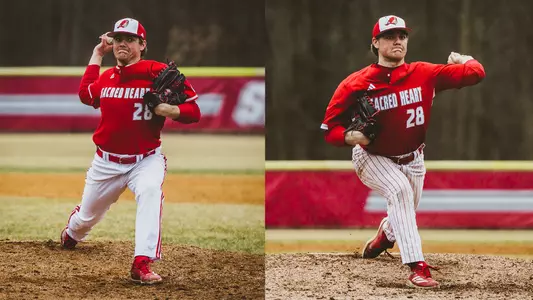
Rogan from both sides
Photo by: John Greene
The Ultimate Athletic Distinction
4/10/2025 1:08:00 PM | Baseball
SHU’s Ambidextrous Pitcher Making an Impact
FAIRFIELD, Conn. - College students aspire to distinguish themselves from their peers while seeking professional opportunities. PJ Rogan is doing that as an ambidextrous pitcher for the Sacred Heart University baseball team.
Rogan, who throws with both arms and uses just one glove, ranks 15th among Division I hurlers with a 1.97 ERA for a Pioneer squad that enters the weekend in fourth place in the Metro Atlantic Athletic Conference.
"PJ is as unique as they come in sports and in baseball," said SHU Head Coach Pat Egan, a former righthanded pitcher who played seven seasons of pro ball. "Being able to throw with both arms is one thing, but to be able to do it at a highly competitive level is another."
There probably isn't a coach or manager at any level of competitive baseball who can mentor a hurler using both arms, it is just that rare. In fact, the SHU sophomore is likely the only one of his kind in college baseball this season, and there's less than a handful who have ever done it in college or professionally.
"I figure it out on my own, and I enjoy doing it that way," says Rogan of the novelty. "It's not easy every day, sometimes one side doesn't feel so great. I will keep throwing from both sides as long as I can do it. I'm just having fun doing it."
Rogan, a St. Louis, Mo., native and natural lefty, learned to throw both ways with his dad, Pat. As a little kid, whatever hand he caught the ball with he would use to throw it back to his dad. Pat noticed the talent and encouraged him to progress while having him pitch an equal amount to strengthen both sides as he matured.
It's strange seeing "LHP/RHP" next to Rogan's name on the team roster, just as it was at Lafayette High School where he earned all-conference and all-district honors for a team that was two-time conference champions. He also played some football and basketball while earning membership in the National Honor Society.
Rogan came to SHU to prove he was more than a show, and Egan allowed his newcomer to do his thing. While Rogan was posting a 3.20 ERA in 19.2 innings last season, there was another college player making headlines with both hands. Mississippi State University's Jurrangelo Cigntje was throwing 90-mile per hour fastballs with both before being taken No. 15 overall in the MLB Draft by Seattle, the organization he is playing for this season. Rogan has a friend from home, Christian Little, who plays for the Mariners, and they are both big fans of Cigntje.
"I love watching another player throw with both arms, and the fact that he (Cigntje) is similar in age to me has made him fun to follow," said Rogan.
An athlete's body, with repetitive use, can be broken in like a new glove. Muscles, like strands of leather, bend to a certain point as part of a routine. Throwing with both arms can challenge the body to maneuver in conflicting ways.
"One of the most challenging parts of being an ambidextrous pitcher is having to balance his throwing program, bullpen routine and recovery daily, but he has found a routine that works for him," said Egan, who in his second pro season played against an ambidextrous New York Yankee prospect.
The prospect Egan saw was Pat Venditte, who became known as the first full-time switch pitcher in Major League Baseball in 2015 with the Oakland A's. Venditte, with his six-finger glove, competed in five major league seasons and totaled 72.1 innings with a 4.73 ERA.
Rogan, who has a six-finger glove from Rawlings with a SHU logo, typically pitches lefty to lefthanded hitters and righty to righthanded batters. He must let the umpire know which arm he will use before the hitter gets in the box. If a switch-hitter approaches the plate, Rogan, who might look for a sign from Egan in the dugout, must indicate what he will do before the batter selects a side.
It's unclear how many ambidextrous pitchers have graced mounds in college and pro baseball, but journeyman Greg Harris became known as the first player in modern MLB history to face batters with both arms in 1995. However, his Montreal Expos manager was reluctant to allow the righty to try the other side, so Harris, in just one inning, faced a hitter righty and then two others lefty. One hundred years before that, Irishman Tony Mullane was baffling batters while pitching - without a glove (easy for him to switch) - for seven different pro teams. Meanwhile, Vanderbilt and Mississippi State have each sent guys to the pros, while Harvard had impact ambidextrous hurlers in both the 1990s and early 2000s.
They have gloves to handle people like Rogan, but baseball statistics were not constructed for ambidextrous pitchers. There is no breakdown of right vs. lefthanded throws. We can see that Rogan has a 3-0 record with 32 innings in a dozen appearances, all in relief. All you can do is ask the SHU sports management major, who figures he has thrown 10 percent more from the left side this season.
"At every level of the game, coaches have asked me why I haven't picked a side. I just want to keep finding ways to be successful using both," said Rogan, who has topped out at 89 with the right and 88 with the left while throwing the same pitches on both sides. "I've always been a strike thrower."
The guy who was wearing an infielder's glove on his left hand playing second base or sporting an outfielder's mitt on his right hand in the outfield was always in the lineup looking for ways to help his team win when he wasn't pitching. However, Rogan has overcome a lot to be a college pitcher. He is under six-feet tall and 185 pounds for a position now known for giants, and he was a late SHU signee.
"PJ came to a summer camp going into his senior year of high school, which was the first time we got a chance to see him throw. It wasn't until the summer before his freshmen year that we made the phone call asking him to be a Pio.," said Egan. "PJ did a great job working on his craft, gaining a few miles per hour on his fastball and dedicating himself to his development. That's why we thought he would be a perfect fit for our program."
Rogan didn't know what to expect coming to SHU so late in the process. He was thrilled to help the Pios win the 2024 Northeast Conference regular season title before barely missing an NEC tournament championship.
"It's been awesome. Coming so close to making the NCAA Tournament was tough. I just want to win this year for the older guys," said Rogan, whose sister, Mollie, was a SHU cross country and track standout before graduating in 2022. "When I get in a game, I just go at them (batters) and attack, and I hope for the best."
The Pioneers hope to attack the remainder of the 2025 schedule and make a run at their fifth Division I NCAA Tournament appearance while playing in their first season in the MAAC.
Rogan, who throws with both arms and uses just one glove, ranks 15th among Division I hurlers with a 1.97 ERA for a Pioneer squad that enters the weekend in fourth place in the Metro Atlantic Athletic Conference.
"PJ is as unique as they come in sports and in baseball," said SHU Head Coach Pat Egan, a former righthanded pitcher who played seven seasons of pro ball. "Being able to throw with both arms is one thing, but to be able to do it at a highly competitive level is another."
There probably isn't a coach or manager at any level of competitive baseball who can mentor a hurler using both arms, it is just that rare. In fact, the SHU sophomore is likely the only one of his kind in college baseball this season, and there's less than a handful who have ever done it in college or professionally.
"I figure it out on my own, and I enjoy doing it that way," says Rogan of the novelty. "It's not easy every day, sometimes one side doesn't feel so great. I will keep throwing from both sides as long as I can do it. I'm just having fun doing it."
Rogan, a St. Louis, Mo., native and natural lefty, learned to throw both ways with his dad, Pat. As a little kid, whatever hand he caught the ball with he would use to throw it back to his dad. Pat noticed the talent and encouraged him to progress while having him pitch an equal amount to strengthen both sides as he matured.
It's strange seeing "LHP/RHP" next to Rogan's name on the team roster, just as it was at Lafayette High School where he earned all-conference and all-district honors for a team that was two-time conference champions. He also played some football and basketball while earning membership in the National Honor Society.
Rogan came to SHU to prove he was more than a show, and Egan allowed his newcomer to do his thing. While Rogan was posting a 3.20 ERA in 19.2 innings last season, there was another college player making headlines with both hands. Mississippi State University's Jurrangelo Cigntje was throwing 90-mile per hour fastballs with both before being taken No. 15 overall in the MLB Draft by Seattle, the organization he is playing for this season. Rogan has a friend from home, Christian Little, who plays for the Mariners, and they are both big fans of Cigntje.
"I love watching another player throw with both arms, and the fact that he (Cigntje) is similar in age to me has made him fun to follow," said Rogan.
An athlete's body, with repetitive use, can be broken in like a new glove. Muscles, like strands of leather, bend to a certain point as part of a routine. Throwing with both arms can challenge the body to maneuver in conflicting ways.
"One of the most challenging parts of being an ambidextrous pitcher is having to balance his throwing program, bullpen routine and recovery daily, but he has found a routine that works for him," said Egan, who in his second pro season played against an ambidextrous New York Yankee prospect.
The prospect Egan saw was Pat Venditte, who became known as the first full-time switch pitcher in Major League Baseball in 2015 with the Oakland A's. Venditte, with his six-finger glove, competed in five major league seasons and totaled 72.1 innings with a 4.73 ERA.
Rogan, who has a six-finger glove from Rawlings with a SHU logo, typically pitches lefty to lefthanded hitters and righty to righthanded batters. He must let the umpire know which arm he will use before the hitter gets in the box. If a switch-hitter approaches the plate, Rogan, who might look for a sign from Egan in the dugout, must indicate what he will do before the batter selects a side.
It's unclear how many ambidextrous pitchers have graced mounds in college and pro baseball, but journeyman Greg Harris became known as the first player in modern MLB history to face batters with both arms in 1995. However, his Montreal Expos manager was reluctant to allow the righty to try the other side, so Harris, in just one inning, faced a hitter righty and then two others lefty. One hundred years before that, Irishman Tony Mullane was baffling batters while pitching - without a glove (easy for him to switch) - for seven different pro teams. Meanwhile, Vanderbilt and Mississippi State have each sent guys to the pros, while Harvard had impact ambidextrous hurlers in both the 1990s and early 2000s.
They have gloves to handle people like Rogan, but baseball statistics were not constructed for ambidextrous pitchers. There is no breakdown of right vs. lefthanded throws. We can see that Rogan has a 3-0 record with 32 innings in a dozen appearances, all in relief. All you can do is ask the SHU sports management major, who figures he has thrown 10 percent more from the left side this season.
"At every level of the game, coaches have asked me why I haven't picked a side. I just want to keep finding ways to be successful using both," said Rogan, who has topped out at 89 with the right and 88 with the left while throwing the same pitches on both sides. "I've always been a strike thrower."
The guy who was wearing an infielder's glove on his left hand playing second base or sporting an outfielder's mitt on his right hand in the outfield was always in the lineup looking for ways to help his team win when he wasn't pitching. However, Rogan has overcome a lot to be a college pitcher. He is under six-feet tall and 185 pounds for a position now known for giants, and he was a late SHU signee.
"PJ came to a summer camp going into his senior year of high school, which was the first time we got a chance to see him throw. It wasn't until the summer before his freshmen year that we made the phone call asking him to be a Pio.," said Egan. "PJ did a great job working on his craft, gaining a few miles per hour on his fastball and dedicating himself to his development. That's why we thought he would be a perfect fit for our program."
Rogan didn't know what to expect coming to SHU so late in the process. He was thrilled to help the Pios win the 2024 Northeast Conference regular season title before barely missing an NEC tournament championship.
"It's been awesome. Coming so close to making the NCAA Tournament was tough. I just want to win this year for the older guys," said Rogan, whose sister, Mollie, was a SHU cross country and track standout before graduating in 2022. "When I get in a game, I just go at them (batters) and attack, and I hope for the best."
The Pioneers hope to attack the remainder of the 2025 schedule and make a run at their fifth Division I NCAA Tournament appearance while playing in their first season in the MAAC.

Players Mentioned

LHP/RHP
/ BaseballSaturday, May 16
Tuesday, May 05
Sunday, April 26
Wednesday, April 22